
The Cuban Heritage Collection will be featuring highlights from Goizueta Fellows’ research investigations conducted during their fellowships. R. Justin Frankeny shares the following about his research on Cuban diasporic musical compositions and experiences in South Florida:
“When I applied for the Goizueta Fellowship, I wrote that I would investigate “the lived experiences and challenges of displacement that Cuban (American) composers faced in Miami amidst competing and sometimes clashing values of the Miami Cuban community, trends in contemporary art music composition, the U.S. government, and Cold War politics” for a chapter in my dissertation. Having now completing my month-long fellowship, I am now convinced that this topic is worthy of my entire dissertation.
During my Fellowship, I maximized my time in the archive by diligently exploring various collections and pursuing intriguing leads, even when they appeared to be potential dead ends. I also took advantage of my time in Miami to explore the city and establish contacts with any living musicians or relatives of musicians involved in the art music scene in Miami during my period of study. As an example of how these interrelated agendas coalesced, I will describe my research journey and findings related to the musical Josephine.
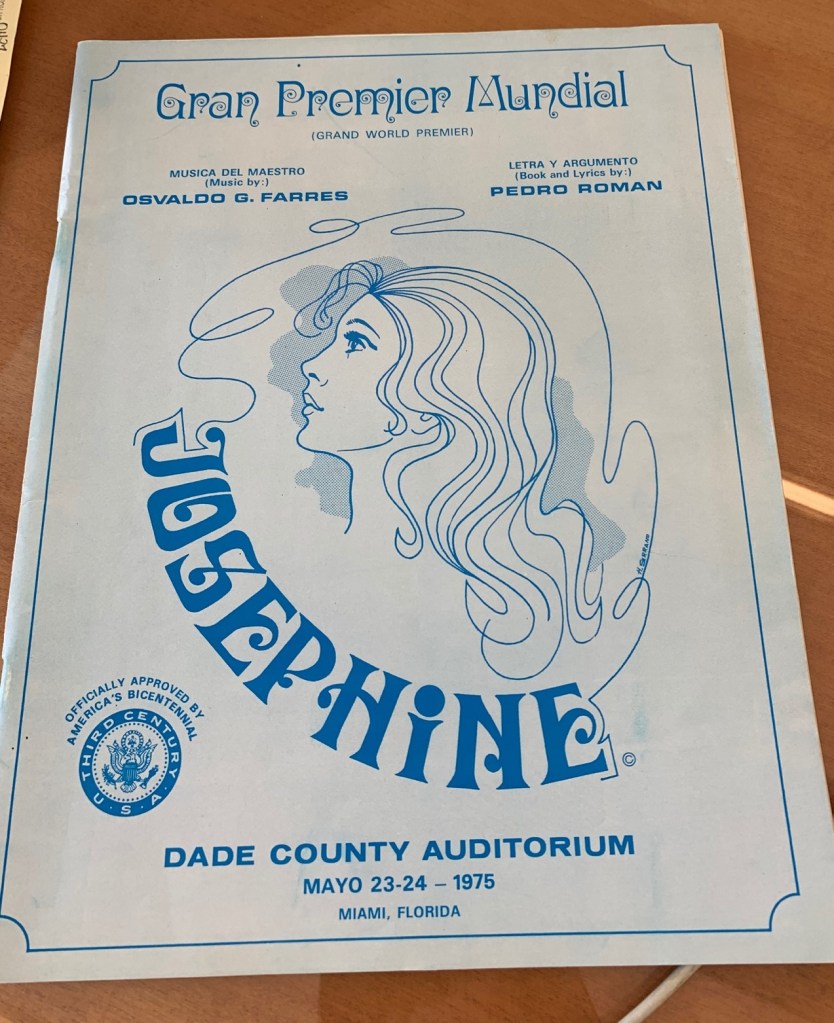
I first discovered the above program in the Manuel Ochoa Papers. Josephine immediately intrigued me because this was the first original work Ochoa conducted that I encountered in his papers. What’s more, the plot described in the program was ripe for allegorical analysis: it follows a Jewish man who travels to Spain to discover his Sephardic roots, where he discovers a beautiful girl Josephine, whom his son promptly falls in love with. Could this be read as an allegory about the relationship between the Miami Cuban artistic community and the older and more established Jewish artistic community in Miami Beach? And how does this play out musically?
While I found newspaper clippings describing the stylistic eclecticism of this work, I sadly found no score or recording in the Manuel Ochoa papers. Luis Colli (CHC Library Technician), pointed out that the CHC holds papers of the composer, Osvaldo Farrés. Unfortunately, there was no score in the Farrés papers either, but I did find a Proclamation for “Josephine Day” by the mayor of Miami in 1975 (pictured below): a testament to the significance of this work.
Still, I persisted. I leaned on contacts at the CHC in an attempt to get in contact with someone who holds a score. Gladys Gómez-Rossié, Elizabeth Cerejido, and fellow CHC researcher and UM professor, Lillian Manzor, were particularly helpful here. In researching Josephine’s librettist, Pedro Roman, who had passed away only five months ago, I discovered that he helped sponsor the creation of the Cuban Culture in Exile Park in Hialeah. Tantalizingly, I found in the park the monument to Josephine pictured below. How is it that a musical work this important is so difficult to find?


Finally, after following up on a contact established by Lillian Manzor, I reach out to a man named Ernesto de Otero, a relative of Pedro Roman, who is in the process of donating Roman’s papers to Florida International University. He agreed to give me access to both his score and recording of Josephine. I now hope to make Josephine the focus of a chapter in my dissertation. Of course, Josephine is only one of my exciting findings during my Fellowship period. And although my time in Miami is now over, I still am working on following up on other contacts I established while I was there. I am now more excited than ever with the new direction my dissertation is taking as a result of the generous support of the Goizueta Fellowship and faculty and staff at the CHC.”
 Cuban Heritage Collection Blog