In this interview, Marley Pulido, historian, community organizer, archivist and founder of “Archivo de Historia Negra de Cuba,” a bilingual digital archive, tells us about the work he does and why he does it.
Tell us about Historia Negra de Cuba. How did you get started? What inspires you topreserve Afro-Cuban history and culture?
This is my favorite question to answer. With the Archivo de Historia Negra de Cuba collide three of my academic passions: history, creative storytelling and archiving. As a History student at the University of Havana, I had the most fun when we were tasked to think beyond history as dates and facts and that’s maybe why the class on Cultural Heritage was so impactful for me. The class focused on family and local history as heritage and I felt so encouraged to be more aware of all the history around me.
Life took many twists and turns since that class, including migrating to the U.S., and it wasn’t until 2018 when my grandpa was diagnosed with cancer, that the thoughts of archiving my family and local history became more clear and urgent. In 2019 I flew home to Cuba and tried to get my grandparents to answer the how did we get here? of my family. I learned a lot from that first interview, including the importance of archiving stories because life is finite. El Archivo is ultimately a deeply personal project, a self discovery quest. My training as a historian won’t let escape contextualizing everything around me so as I learn to become a community archivist, I also do extensive research and try to share the knowledge and findings in creative ways. I’m finding a whole lot of freedom in combining creativity, storytelling and archiving.
Are there items or stories related to the digital archive you would like to highlight?
I feel indebted to El Cerro. In this journey of telling and collecting my family’s stories, I’ve had to always come back to our surroundings, the geography, the sounds, the colors and the architecture. Growing up I loved the sumptuosity of the pillars and high ceilings and the portales of las casonas del Cerro. You could tell that even when our infrastructure was/is so neglected, el barrio lived better and more colorful days.
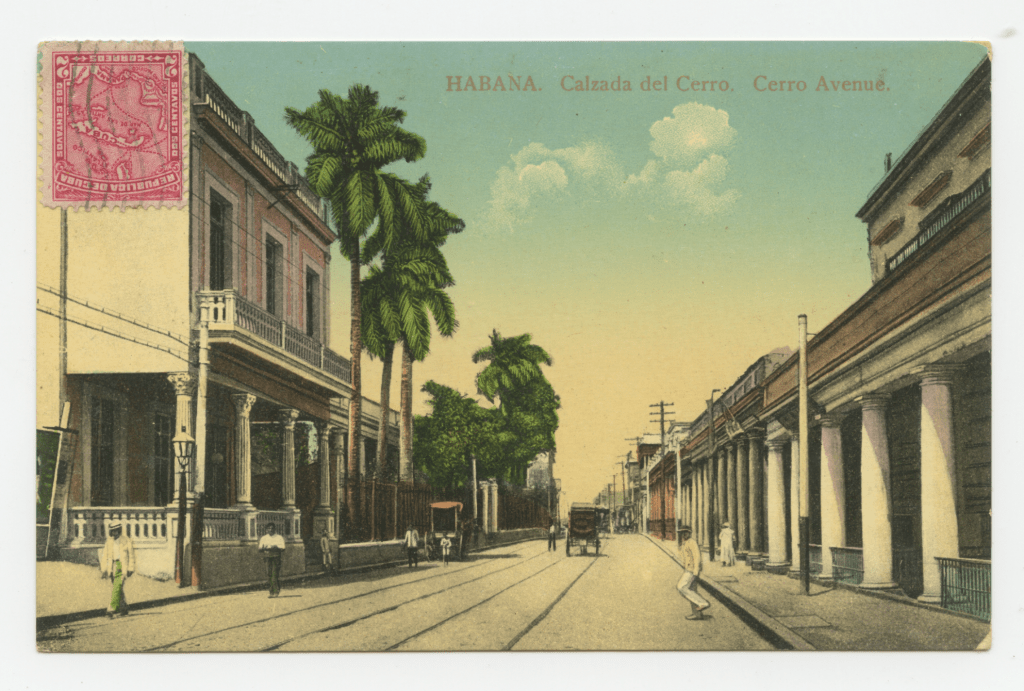
My favorite things to collect these days are photos and postcards of El Cerro. I remember the first time I bumped onto one of those vintage postcards from the early 1900s. I hadn’t even read the description and I internally shouted: omg that’s La Esquina de Tejas. I love to time travel through images. I just wish that in the face of government neglect, there were more community initiatives to restore and preserve a town full of so much history.
Postcard of Calzada del Cerro, circa 1916. From the El Cerro Collection.
How do you collaborate with community members?
I’m not doing this community archivist work full time (yet!) and a lot of creative ideas have to be tabled for the future because my capacity is limited. I try to embed co-creating with community members, artists and activists into every aspect of El Archivo. I can’t do this alone. I’m always open to collaborations, whether it is creating merch or social media campaigns or doing research.
I also really love the crossover from existing digitally to interacting with the community in person. The “Cuban-American Historical Exhibition at the White House” on April 18 of this year was a peak of this crossover. On one hand, it was a dream to co-curate the exhibition with the Cuban Heritage Collection. A dream and a pleasure. On the other hand seeing the community interact with the items, particularly with the photos of Cloe Cabrera and then seeing her there and chatting with her, left me very inspired. I do this work because I want people to feel the same passion and connection towards history that I feel.
Have you faced any challenges in your community archiving work? How have you dealt with them?
The main challenge has been time. A lot of the work feels urgent, especially collecting oral stories. I had to deprioritize interviews during the peak of the pandemic because life was upside down and it was quite impossible to visit Cuba, but then my grandmother passed away and with her I lost what was anchoring the project at the time. All the questions I had for her suddenly didn’t make sense or had to be reframed or answered by someone else. I’ve had to come to terms with the fact that time is limited and I have many other responsibilities. I don’t feel guilt anymore when I have to put my community archiving work on pause but I wish I had more time… and funding!
What are your goals for the future of the archive?
I’m working on curating four collections at a time, writing a book and building the digital infrastructure to make the collections public. It’s a lot of work. My most immediate goal is to get funding that grants me creative freedom and helps me scale up the project. Not a goal but a dream is to house some of the collections back home, in El Cerro.
[Reading the newspaper at the bus stop] by Julio Bello, circa 1980. From theEl Cerro Collection.


 Cuban Heritage Collection Blog