
By Fernando Espino, CHC Student Assistant
Tony López’s studio, located in the Wynwood 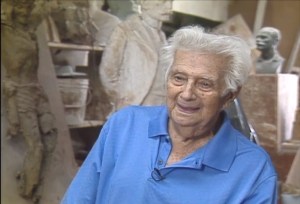 neighborhood, was a community landmark, with customers, art fanatics, and curious passers-by coming in throughout the day. Always present was the sculptor himself, an energetic figure who was constantly hard at work, even into his nineties.
Tony Lopez (1919-2011) was born into an artistic family. Both his father and grandfather were sculptors by trade, and Tony joked that he was born with a piece of clay in his hands. Sculpture was his life’s passion since as far back as he could remember. As he put it, he never wanted to do anything else. His father passed away when Tony was 18, and the young artist finished the project his father had been working on. This was Tony’s first commissioned sculpture.
In Cuba, Tony was best known for his caricature sculptures. Though he was never overtly political himself, he often mocked the political figures of the day through his work. His first caricature, of President Ramon Grau, became infamous in the Cuban political community.
He and his family fled the Cuban Revolution in 1958, and Tony set up his studio in Miami, where he completed hundreds of sculptures. His most famous works include the monument to José Martí in New Orleans, the Torch of Friendship in Miami, and works displayed at the Holocaust Memorial in Miami Beach. He is also famous for his rooster figures that adorned Calle Ocho. These were based on his pet rooster, Pepe, who would wander freely through the studio during the day.
Tony López passed away in August of 2011. A passionate artist who was determined to make a living doing what he loved, Tony dedicated himself to his craft and became a recognized artist of the Cuban diaspora. His art has left its mark in Cuba, Miami, New York, New Orleans, Grand Cayman, and in the hearts and minds of the Cuban community.
- Tony López was interviewed as part of the Luis J. Botifoll Oral History Project in Miami, FL on June 13, 2009. To learn more, watch Mr. López tell his life story.
- More from the Luis J. Botifoll Oral History Project »

