
The Cuban Heritage Collection will be featuring reports authored by CHC Short-Term Research Grant awardees. These reports highlight insights from researchers’ short-term visits to the Collection. Here, Dr. Ted. A. Henken shares findings related to his research project titled “Saturn’s Children: The 60-Year Struggle to Reestablish a Free Press in Cuba.”
As a sociologist my experience doing archival research has been rather limited. So, being able to spend three weeks digging around in the CHC archives (after a 20+ year career where my research has been primarily made up of participant observation and in-person interviews) was a real treat. I discovered that documentary evidence is key to accurately telling a story and that old, dusty documents have a lot to say!
Also, in undertaking my archival research on the history of Cuban independent journalism, I found myself in an advantageous position. Having already written the lion’s share of my book manuscript, I was able to focus my work in the archive very narrowly on the independent press agencies (APIC, BPIC, Cuba Press, etc.) and people (Yndamiro Restano, Iraida Montalvo, Soren Triff, Raúl Rivero, etc.) I have already written about, double checking my understanding and in some cases deepening or adding important nuance to the profiles that make up my book.
Thus, having access to the Buró de Periodistas Independientes de Cuba (BPIC) papers (CHC 0558), three copies of the BPIC publication “El Independiente,” the Ricardo Bofill Pagés Papers (CHC 0032), the Soren Triff Papers (CHC 5132), the vertical file on Raúl Rivero (CHC 5261), and the Cuban journalism pamphlet collection (OCLC No.:55153734) provided me with a trove of new material with which to work.
My research findings were many. First, poring over the documents and correspondence that I found in the organizational archives of some of the independent press agencies allowed me to find primary source evidence of the difficult relationships, rivalries, controversies, and schisms that existed among the members of these groups.
Second, I uncovered evidence of the web of people and support systems that independent journalists relied on outside of Cuba to make sure their work saw the light of day. Iraida Montalvo and Soren Triff were two key discoveries here whom I was only marginally aware of before.
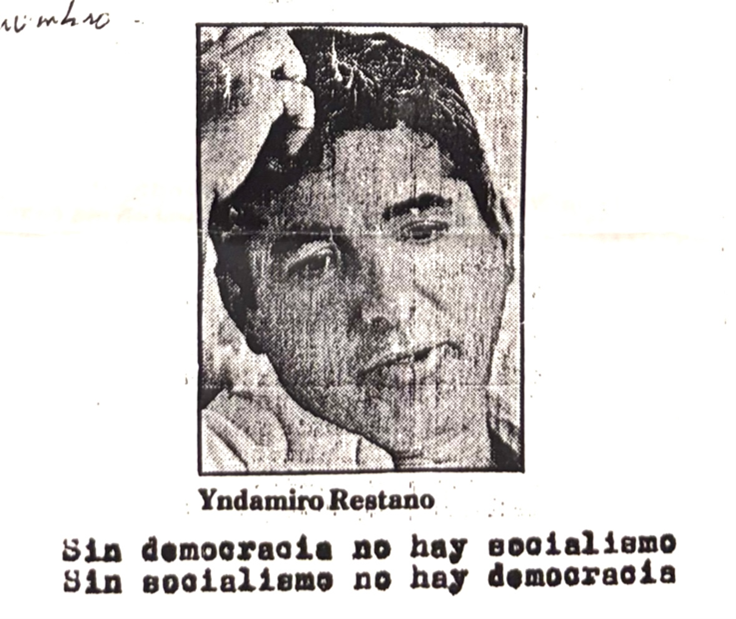
Third, I uncovered the key documents, declarations of principles, organizational histories, and evidence of changes of leadership of the various organizations that I highlight in my manuscript. This included the founding documents of Movimiento Armonía (MAR) and the Buró de Periodistas Independientes de Cuba. (See below for a photo extracted from MAR’s founding document with the words “Without democracy there is no socialism, without socialism there is no democracy.”)
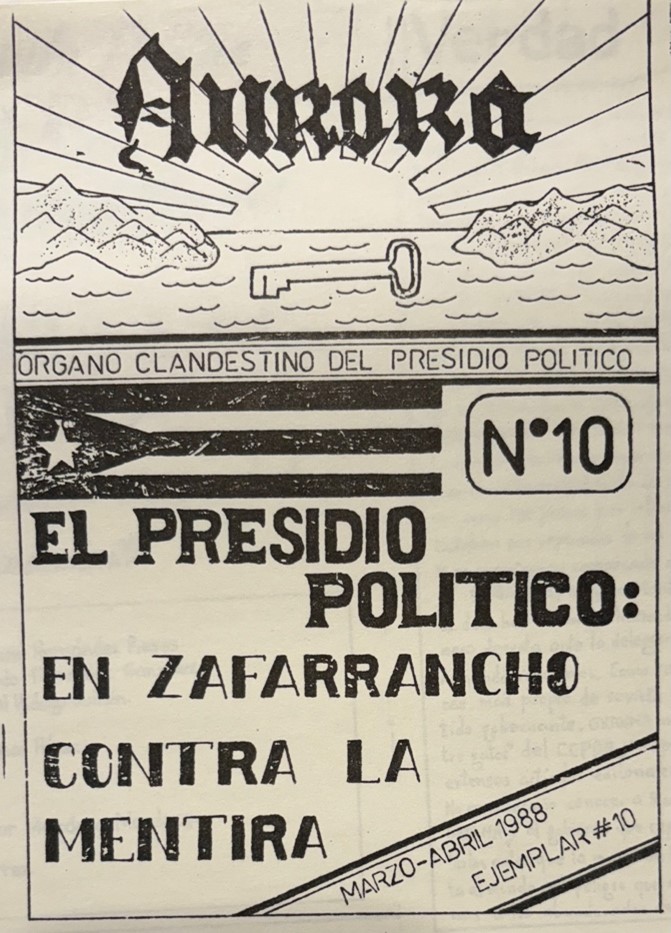
Finally, in the Ricardo Bofill Pagés Papers, I uncovered a complete copy of Aurora, a hand-written clandestine independent magazine of 22 pages edited by Ariel Hidalgo and published from jail by a group of Cuban political prisoners in the late-1980s – making it one of the first published documents of Cuban independent journalism. [See below for a photo of the cover of that magazine].
Before closing, I want to add a special note about the Carlos Alberto Montaner collection (CHC 5045). I had requested to see this collection since Montaner was a key exile ally of Cuba’s independent journalists and often acted as a go-between for them abroad and published some of their work at Firmas Press. However, given the fact that the enormous collection of 40 boxes is housed mostly off-site and does not yet seem to be indexed or inventoried so that a researcher can avoid going through all the boxes one-by-one and zero in on specific contents, I was only able to review one of the 40 boxes in that collection.
However, I was able to use this unexpected down time during my stay at the CHC to make a quick two-day visit to the Cuban human rights archive donated by Ariel Hidalgo to the special collections department of FIU’s Green Library. There, I was able to uncover materials related to my topic that complemented the holdings at CHC.
I plan to finish my book manuscript in the fall and submit it to the University of Florida Press, to which it is already under advance contract. I expect that it will be published in late 2026.
 Cuban Heritage Collection Blog