
The Cuban Heritage Collection will be featuring highlights from Goizueta Fellows’ research investigations conducted during their fellowships. Maytte Hernández Lorenzo, shares the following about her research on 21st Century theatrical production in the Caribbean islands of Cuba, the Dominican Republic, and Puerto Rico:
My research conducted at the Cuban Heritage Collection as a 2025-2026 Goizueta Graduate Research Fellow focused on the articulation between cultural policy and the socioeconomic context during the period mainly spanning the late 1960s, early 1970s, mid-1980s, and the second decade of the 2000s. This coincided with the analysis of theatrical experiences such as Teatro Escambray, Los Doce, the play La cuarta pared by Víctor Varela, the platform Laboratorio Escénico de Experimentación Social (LEES, 2012–2020), as well as the play La bahía by Alessandra Santiesteban (2018). These experiences are part of the body of work I analyze in my doctoral dissertation in relation to the concepts of expanded scene (escena expandida) and convivial citizenship (ciudadanía convivial)—axes of an analysis that also extends to Puerto Rico and the Dominican Republic.
As part of my analysis, I also examined different sources and materials that allowed me to trace cultural policies prior to the Revolution and, from there, to reconstruct a narrative that challenges the myth of 1959 as the “zero point” in terms of an institutional cultural system and the interferences between political discourse and creative strategies.
For two months, Monday through Friday, I had the privilege of “diving” into archives, books, documents, and ephemeral materials that could guide me along this critical path. Thanks to my “archive fever,” I followed routes that had not been previously mapped, which led me to incredible surprises—partly due to my own lack of prior knowledge—and was always supported by the CHC specialists, who were decisive in the outcomes of this stage of my research. To them, I am forever grateful.
If I were to synthesize some of the findings that impacted my research, I could mention, for instance, abundant evidence of an institutional system—state, private, associated, mixed—that relied on various alliances to develop its work. Among these alliances, for example, was the one maintained between the Dirección de Cultura (attached to the Secretary of Education) and the Federación Estudiantil Universitaria prior to the political uprising led by Fulgencio Batista.
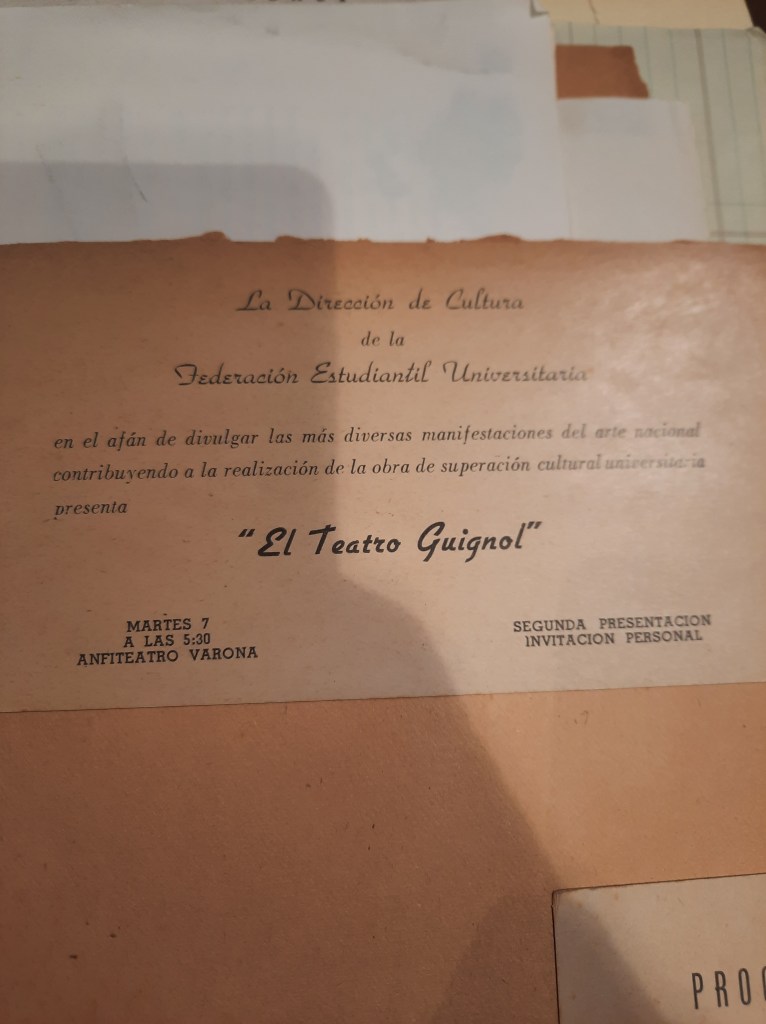
In this same collection, I found, among the ephemeral materials, a playbill in which one can observe the interference of the state institution superimposing a narrative of control and censorship over artistic work. The exact year in the 1950s cannot be determined in photo number 2, but I can suspect that it is from before the 1959 period, because the collection also includes a playbill (photo number 3) where the positioning of the prevailing ideological and political discourse can be explicitly read. Both documents show how the playbill and program were interceded by political power.


Another important finding for my research was the discovery of Mario Sorondo—playwright, entrepreneur, actor, promoter, and co-author with Teurbe Tolón of the book Treinta años de teatro—which in its opening pages informs the reader: “The profits from this book will be dedicated to the construction of a portable theater that will travel throughout the Republic of Cuba as cultural and patriotic propaganda in support of Cuban theater and displaced artists” (5). Sorondo—who is scarcely mentioned in the historiography of Cuban theater—built three portable stages in 1928 with a capacity for more than one thousand spectators. This initiative sought to mitigate the negative impact of cinema, since many theaters had been converted into movie theaters. As a precedent of the expanded scene—one that overflows the physical theater building—it is an example of the impact of cultural policies and the agency of creators.
 Cuban Heritage Collection Blog