
The Cuban Heritage Collection will be featuring highlights from Goizueta Fellows’ research investigations conducted during their fellowships. Arturo Sebastian Gonzalez argues that Cuban consulates in the early 20th century functioned not only as protectors of émigrés but also as politically charged spaces where individual consuls, like Miguel Ángel Campos Conde, could leverage personal loyalty and autonomy to defy state authority during moments of national crisis.
Honor and Intrigue: Cuban Consuls Gone Rogue
According to Rafael de la Torre’s 1918 Manual de Derecho Consular, the most important function of a Cuban diplomatic consul was to serve and protect the interests of local Cuban emigres. Referring to the “protective mission that consuls have with respect to their compatriots,” de la Torre instructs Cuban consuls posted abroad to, “work with local authorities in order to prevent compatriots from becoming victims of abuses of power or denial of justice, and to obtain the appropriate reparations in any such cases.”[1] To that end, consuls were imbued with responsibility to cultivate sufficient social capital among both emigres and locals in order to function as an effective mediator. Ideally, a Cuban consul would simultaneous wield his personal honor and the sovereign authority of the Cuban state to defend members of the Cuban nation who were living abroad.
There are many examples of consular intervention protecting Cuban emigres from harm. In 1912, consul Rafael Martinez Ybor likely saved the lives of Afro-Cubans in Tampa, Florida by using the local press to dissuade white, would-be vigilantes of the notion that black Cubans in the city were secretly plotting a race war.[2] In 1927, the quasi-official publication Revista Diplomatica proudly reported that consul José Antonio Ramos in Philadelphia, Pennsylvania donated his blood to save the life of Cuban emigre Eduardo Solar after the latter man suffered a serious accident.[3] Within my broader dissertation project, I use these triumphal examples of consular diplomacy to argue that consulates were critical vectors through which Cuban statesmen promoted and legitimized an orthodox interpretation of Cuban nationalism–one that emphasized loyalty to a paternalistic political elite.[4]
Nevertheless, directing consuls to cultivate personal clout proved to be a double-edged sword. Consuls were impowered to independently and proactively solve issues within their community, which reflected well on the Cuban republic and its political establishmen. But, this arrangement also ensured that consuls had an independent well of support with which to move against their superiors at junctures of political disagreement. During those times in which a consul’s personal honor and the government’s official policies were at odds, a dirty contest was liable to ensue over who could better rally emigre communities to their schismatic interpretation of cubanidad. This is exactly what happened when a pro-Machado consular office in Miami refused to recognize the authority of President Ramón Grau San Martín’s government in the wake of the Revolution of 1933.
Documenting the deliberations and actions of these rogue consuls faces an evidentiary problem. Before serving as a Goizueta Graduate Fellow, I had already reviewed thousands of letters in the Asuntos Consulares collection of the Archivo Central del Ministerio de Relaciones Exteriores in Havana. While illuminating in their way, I found that the utilitarian prose and proscribed syntax of official diplomatic correspondence obscures, in most cases, the personal emotions and passions of consular agents.[5] I was able to find some colorful information in newspaper articles. In 1934, Miami News called the concentration of revolutionaries and counter-revolutionaries, “Miami’s Own Whirligig.”[6] But, the available press reports lack insiders’ perspectives. It was with profound gratitude, then, that I discovered the archival stewards at the Cuban Heritage Collection and their community of donors had preserved a number of examples of private correspondence with consular officials. The rich, candid letters in the Gerardo Machado y Morales Papers proved particularly helpful at shedding light on the actions of vice-consul Miguel Angel Campos Conde, the aforementioned rogue machadista consular officer in Miami.
On August 24, 1933, viceconsul Campos wrote a letter on official consulate stationary to Ignacio Baldomero Grau, Gerardo Machado’s son-in-law, business partner, and all-around close confidant. Written less than two weeks after Machado had been ousted as President of Cuba, Campos tells Machado’s yerno to, “always remember that I am here for whatever you might need from me privately or as Viceconsul, but in any case I will always be the same ‘Campitos…'”[7]
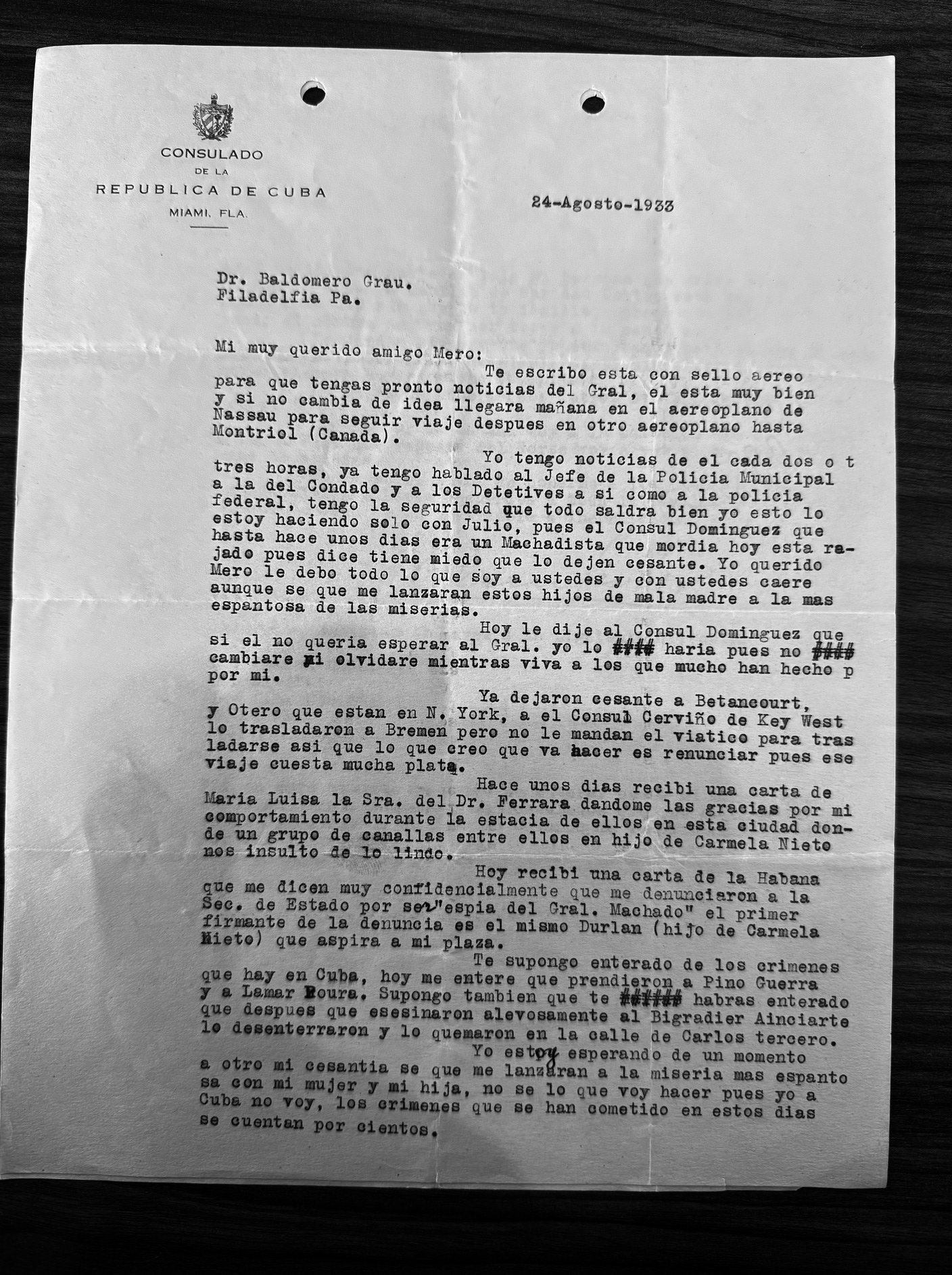
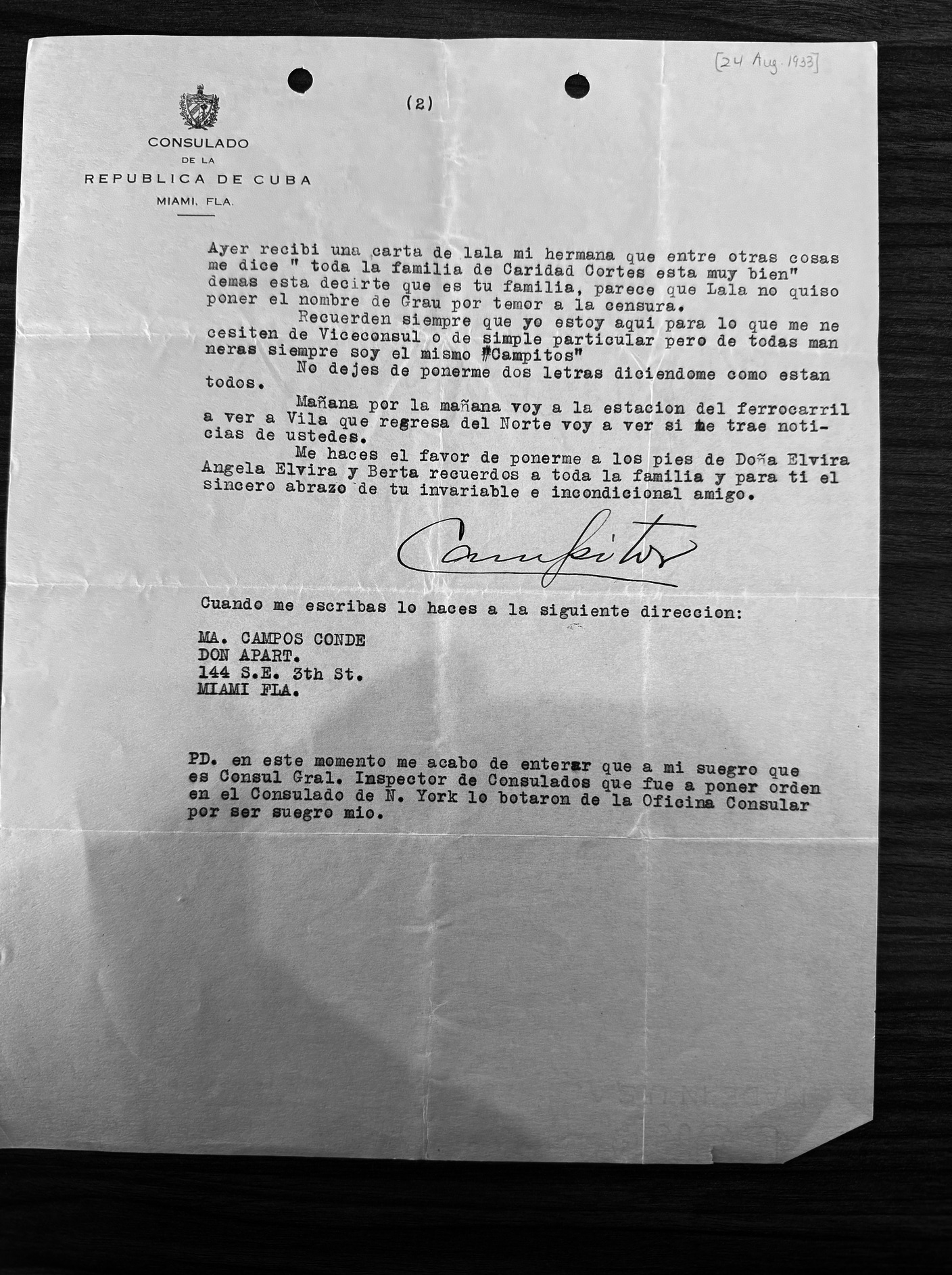
On September 9, 1933, viceconsul “Campitos” wrote a letter directly to ex-president Machado, lamenting the current state of affairs: “anarchy, communism, crime, and robbery; right there in four words is the present state of our beloved fatherland.”[8] Pronouncing his continued loyalty to the deposed president, Campos goes on to declare, “Dearest General, know that I will always be available for any reason you may need me, that I am at your disposal, and that nothing nor nobody will alter the grand affection, gratitude, and respect I have for you.”[9]
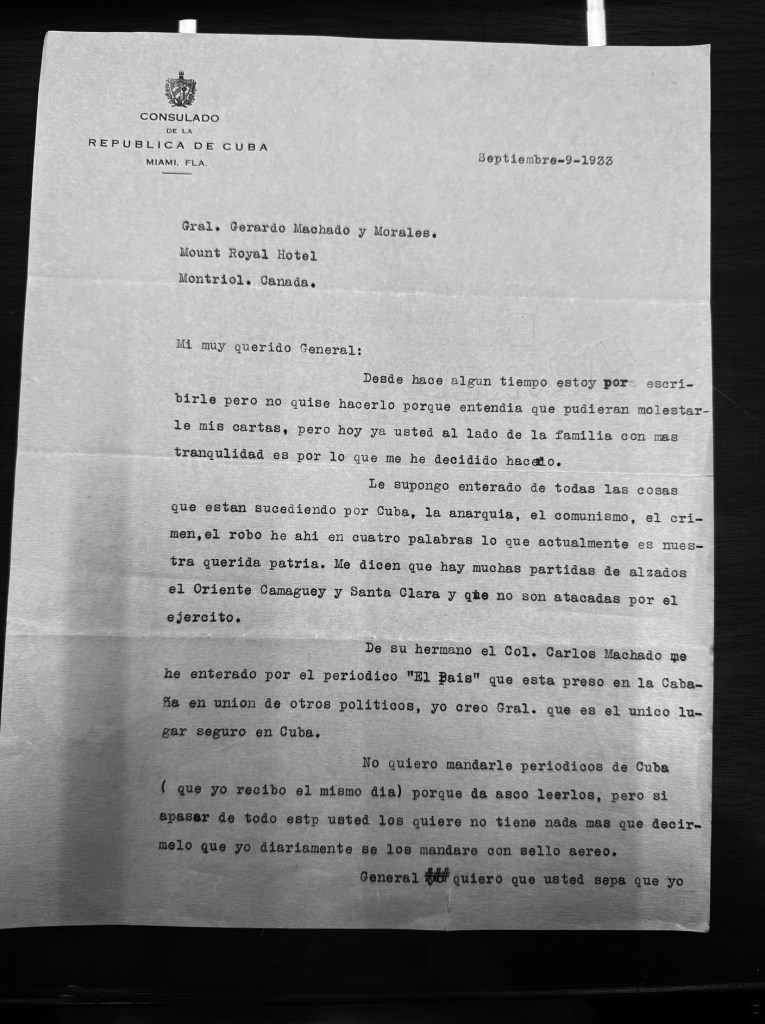
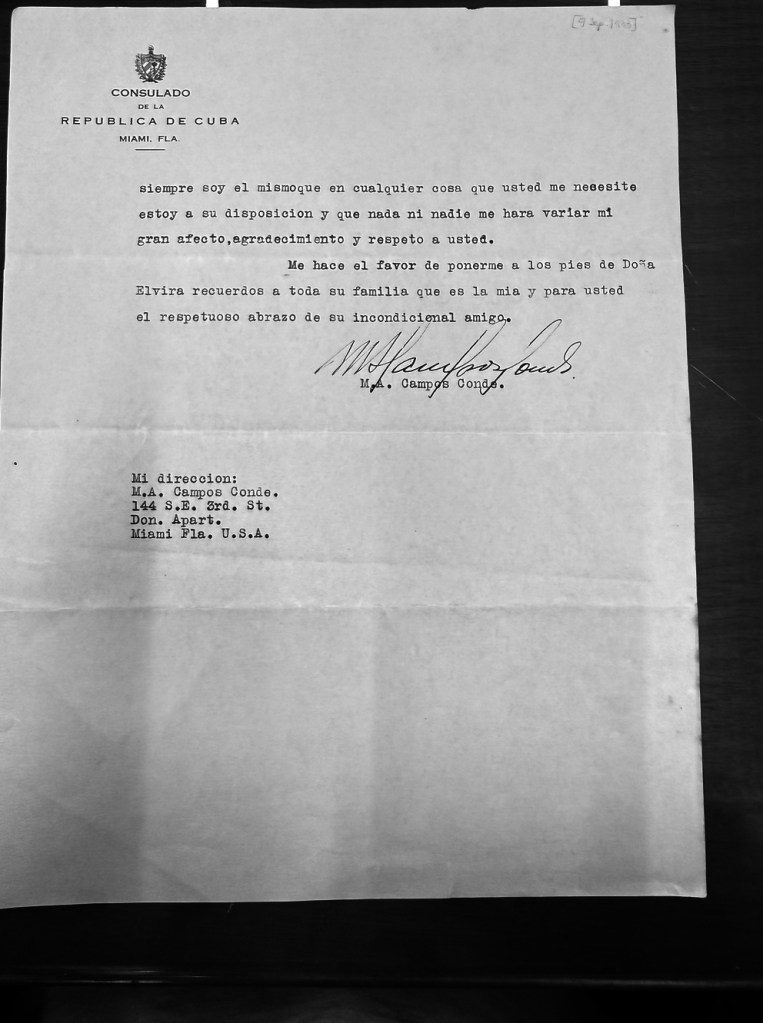
True to his word, the viceconsul remained steadfastly loyal even as anti-machadista forces pressured him from all sides. Campos describes having received confidential information that, “they have denounced me [in Havana] to the Secretary of State for being ‘a spy for General Machado.'”[10] Other Cuban diplomats who were apparently deemed too sympathetic to Machado were shuffled off to far-flung consulates in Europe, or outright fired. Campos did not even trust his direct superior, Consul Conrado Dominguez. Dominguez had, “until just a few days ago been a machadista with a bite, today he is cowardly, saying that he is afraid they will leave him unemployed.”[11] Campos reported sharing stern words with his boss, “Today I told Consul Dominguez that if he did not want to wait for the General, I would, because I shall not change nor forget while those who have done so much for me still live.”[12] Campos’s words seem to have strengthened Dominguez’s resolve. When the Grau San Martin administration attempted to install their own man to head the Miami consulate, Dominguez stood his ground, refusing to hand over control of his office in October of 1933.[13] Bolstered by the fact that the United States never recognized the legitimacy of President Ramon Grau San Martín, nor the credentials of his diplomats, Dominguez and Campos were able to keep the resources of the Miami consulate under the control of machadista loyalists.
Practically speaking, control of the consulate empowered Campos and his associates to do things like successfully pressure the local police to protect Gerardo Machado’s family from harassment when they passed by Miami on a train, en route to New York City. Ten anti-Machado protestors were arrested during the altercation.[14] On other occasions, he help organize pro-Machado political meetings in Miami Beach.[15]
Likeminded machadistas posted to other consulates played a significant role in smuggling Machado out of the United States when he was at risk of extradition back to Cuba. In 1934, Machado was living in exile with his family in New York City, when a warrant was issued by U.S. authorities for the ex-president’s arrest, based on a request to extradite him back to Cuba. According to an oral history interview with Machado’s granddaughter, María Grau de Santeiro, the exiled president received advanced warning via phone call from a sympathetic staff member in the Cuban Consulate General of NYC. Machado left his home minutes before the warrant was executed by a team of local and federal police officers.[16] Machado managed to evade capture and escape to the Dominican Republic on a chartered yacht.[17]
With hindsight, Miguel Angel Campos Conde’s actions may seem downright foolhardy. A machadista counter-revolution never materialized. Campos finally resigned as viceconsul in January 1934, in protest over the fast-growing influence of the military over civilian leadership in Cuba.[18] Events simply got away from the machadistas, and few people today remember, let alone respect, the efforts of Liberal Party partisans during the Revolution of 1933. Their actions after Machado’s exile on August 12, 1933 have long been confined to the dustbin of history. The only consolation they may have felt was in appreciating the irony that the revolutionaries who had exiled them in 1933 were subsequently exiled themselves after Fulgencio Batista y Zaldívar’s coup d’état in 1934. But in practical terms, Campos ultimately received nothing but hardship in return for his loyalty to Gerardo Machado.
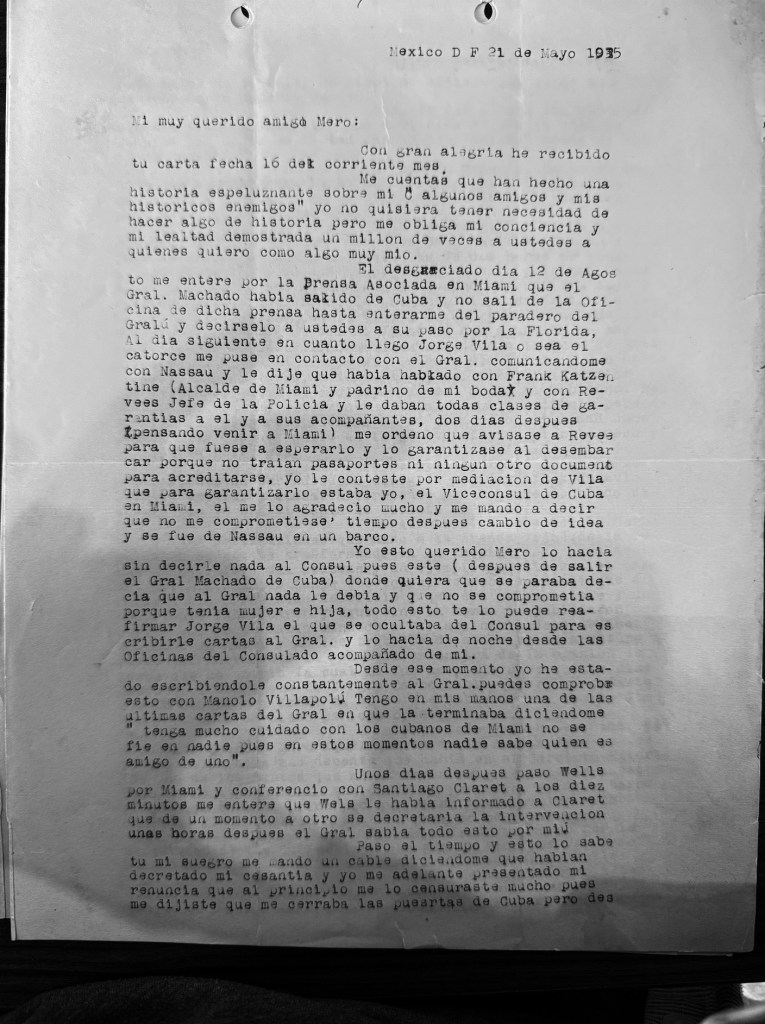
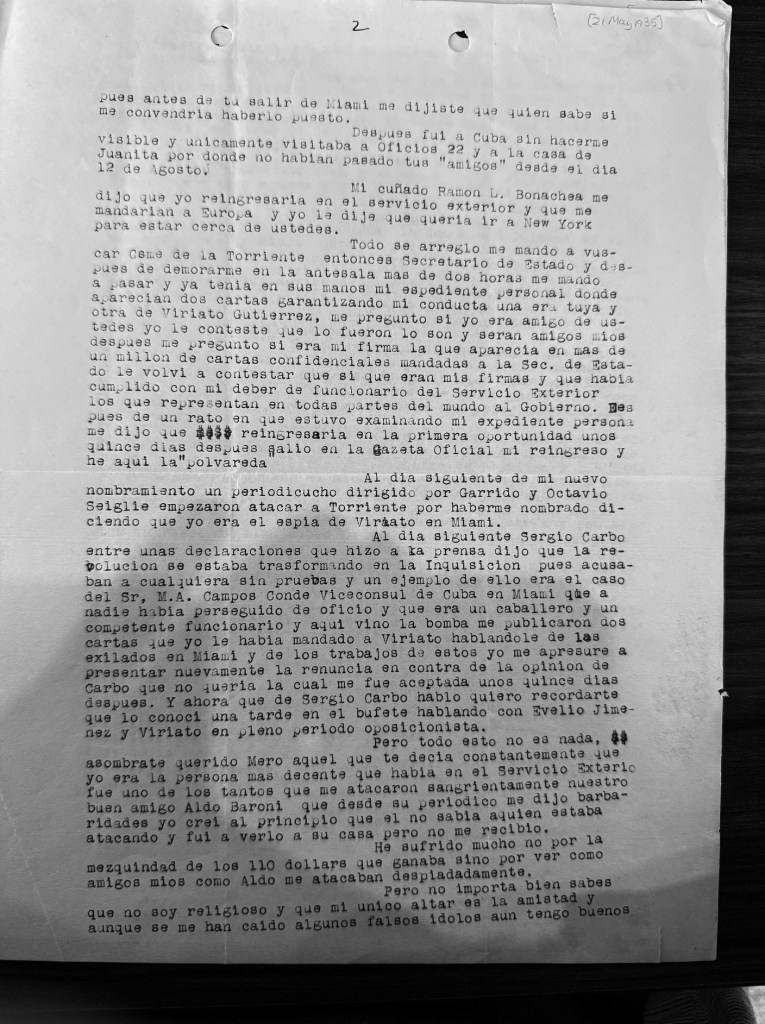
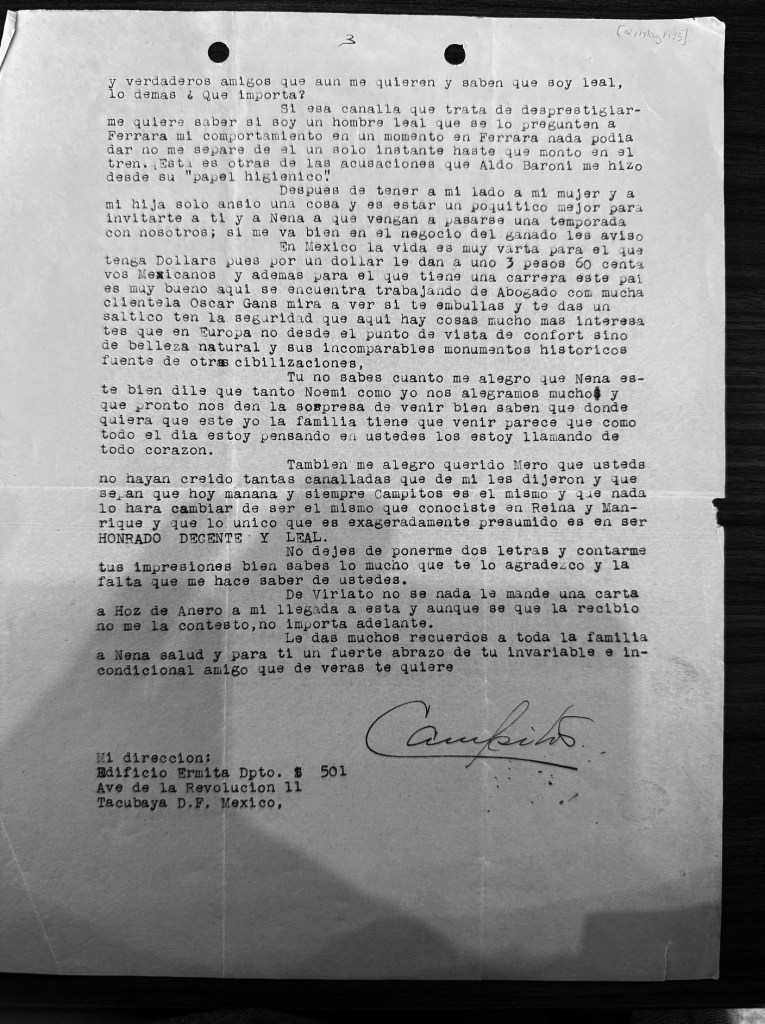
Yet, the logic of honor often has little to do with pragmatism. In a letter from May 21st, 1935, written by Campos from his exile in Mexico City, the former viceconsul reflected on his actions, saying, “I have suffered greatly, not because of the pittance of a 110 dollars I used to earn, but rather from seeing how friends of mine like Aldo [Baroni (a newspaper mogul in Cuba)] mercilessly attacked me. But it does not matter, you know well that I am not religious and that my only alter is friendship, and although some false idols of mine have fallen, I have good and true friends who love me and know that I am loyal; the rest, what does it matter?”[19] All to often, we assume that historical figures–particularly those defending the status quo–must have been cynical and self-serving. Campos’s surviving correspondence demonstrates that, for better or for worse, he genuinely believed in a particular vision of what values and duties were demanded of patriotic Cuban citizens. The structure of his position as a consular officer, empowered him, perhaps even obligated him, to act in furtherance of what he believed would bring honor to la patria, even if those acts contradicted new orders from Havana. To conclude this is not to defend the actions of the machadistas, but rather to set them within their forgotten context, while also shedding light on institutional features of the Cuban diplomatic corps that are relevant to the outcome of various other political inflection points before and after this specific time and place.
Taken together, all these episodes reveal Cuban consulates not merely as administrative outposts, but as contested political arenas where ideas of nationalism, personal honor, and state authority were constantly renegotiated. While consuls often fulfilled their protective mandate with tangible benefits for émigré communities and a legitimizing effect for the Cuban government in Havana, the autonomy of the consuls also created space for dissent and rupture during moments of national crisis. By turning to the private correspondence preserved in the Cuban Heritage Collection, my project recovers the personal and clandestine perspectives of how consular power was used to define the contours of cubanidad.
[1] Rafael de la Torre y Reiné, Manual de Derecho Consular Cubano (Havana: Imprenta El Siglo XX, 1918), pp 70. Translated from Spanish.
[2] “Society Plans Aid to Rebels,” Tampa Tribune, August 24, 1906; “Seven Hundred Ready to Fight,” Tampa Tribune (Tampa, FL), 30 August 1906.
[3] “El Cónsul que da su Sangre,” Revista Diplomatica Año 2, Num. 11-12 (November & December 1927.
[4] For further reading on the contested emergence of nationalist orthodoxy during the early decades of the Cuban republic, see Lillian Guerra, The Myth of José Martí: Conflicting Nationalisms in Early Twentieth-Century Cuba (Chapel Hill: University of North Carolina Press, 2006).
[5] Standards for Cuban diplomatic correspondence are laid out in foreign service training manuals such as de la Torre y Reiné, 1918, and Miguel Figueroa y Miranda, Manual Diplomatico: Edicion Provisional (Havana: Ministerio de Estado, 1959).
[6] “Miami’s Own Whirligig,” Miami News, 04 October 1934, pp 1.
[7] Miguel Angel Campos Conde to Ignacio Baldomero Grau, August 24th, 1933. Gerardo Machado y Morales Papers, Cuban Heritage Collection, University of Miami Libraries, Coral Gables, Florida. CHC0336, Box 4, Folder 1.
[8] Miguel Angel Campos Conde to Gerardo Machado y Morales, September 9th, 1933. Gerardo Machado y Morales Papers, Cuban Heritage Collection, University of Miami Libraries, Coral Gables, Florida. CHC0336, Box 2, Folder 3.
[9] Ibid.
[10] Campos to Grau.
[11] Ibid.
[12] Ibid.
[13] “Diplomacy to Settle Cuban Consul Dispute: So Says President Grau San Martin Appointee Who is Refused Office,” Miami Herald, October 17th, 1933.
[14] Folder of declassified material copied from U.S. Department of Justice records, regarding, “Arrest of Cuban revolutionists in Florida for demonstration against Mrs. Machado and party at Miami,” dated August 29th, 1933. Gerardo Machado y Morales Papers, Cuban Heritage Collection, University of Miami Libraries, Coral Gables, Florida. CHC0336, Box 14, Folder 8.
[15] Miguel Angel Campos Conde to Ignacio Baldomero Grau, September 12th, 1933. Gerardo Machado y Morales Papers, Cuban Heritage Collection, University of Miami Libraries, Coral Gables, Florida. CHC0336, Box 4, Folder 1.
[16] Interview with María Grau de Santeiro. Interview by Julio Estorino. Miami, Florida. February 20th, 2010. Luis J. Botifoll Oral History Project, Cuban Heritage Collection, University of Miami Libraries, Coral Gables, Florida. chc5212000019.
[17] For copy of extradition proceedings and other documents about these events, see Gerardo Machado y Morales Papers, Cuban Heritage Collection, University of Miami Libraries, Coral Gables, Florida. CHC0336, Box 15.
[18] “Renuncian Seijas y Campos”, Miami News, January 10th, 1934.
[19] Miguel Angel Campos Conde to “Mero,” May 21st, 1935. Gerardo Machado y Morales Papers, Cuban Heritage Collection, University of Miami Libraries, Coral Gables, Florida. CHC0336, Box 4, Folder 7.
 Cuban Heritage Collection Blog