
The Cuban Heritage Collection will be featuring reports authored by CHC Short-Term Research Grant awardees. These reports highlight insights from researchers’ short-term visits to the Collection. Here, community archivist and independent researcher Librada González Fernández reconstructs the lives and roles of queer and trans individuals in mid-20th-century Cuba using fragmented, often biased archival sources while expanding methods to uncover marginalized histories.
Queerness, crossdressing and sex work in mid-twentieth century Cuba
Queer and trans narratives in the historical record are shaped greatly by: (a) a robust tradition of censorship and repression which has deemed these stories immoral or even historically irrelevant, (b) the lack of necessary resources available to its subjects to be able to speak about their lives in first person, and (c) the social stigma and possible repercussions associated with being openly queer. As a result, most documents that have been preserved in institutional collections contain (often moralizing) third person descriptions which violently misrepresent the lived experiences of queer and trans subjects. Though seemingly contradictory, the process of working in a highly specific field such as “mid XX century queer Cuban history”, requires a more expansive approach to research because entering “queer Cuba” into a database, for example, will yield results that leave much to be desired.
Working within this amplified scope during my time at CHC has been helpful not only in increasing my chances of finding material but also understanding the broader social context in which the research existed. A series of five volumes [1] on Cuban celebrities by entertainer and historian Rosendo Rosell was one of my early leads. Then the Rosendo Rosell Papers [2] which included a treasure trove of published and unpublished photographs. Rosell’s gift to the Cuban Heritage Collection is a meticulously documented testament of twentieth century Cuban culture. Although the boxes were unprocessed and I did not have a chance to see them all, I can confidently say that this collection has the potential to become one of CHC’s most requested materials. Worthy of note are the photos of Marina Cuenllas, the famous matron who ran the eponymous brothel “Casa Marina” located in the historic Barrio Colón.
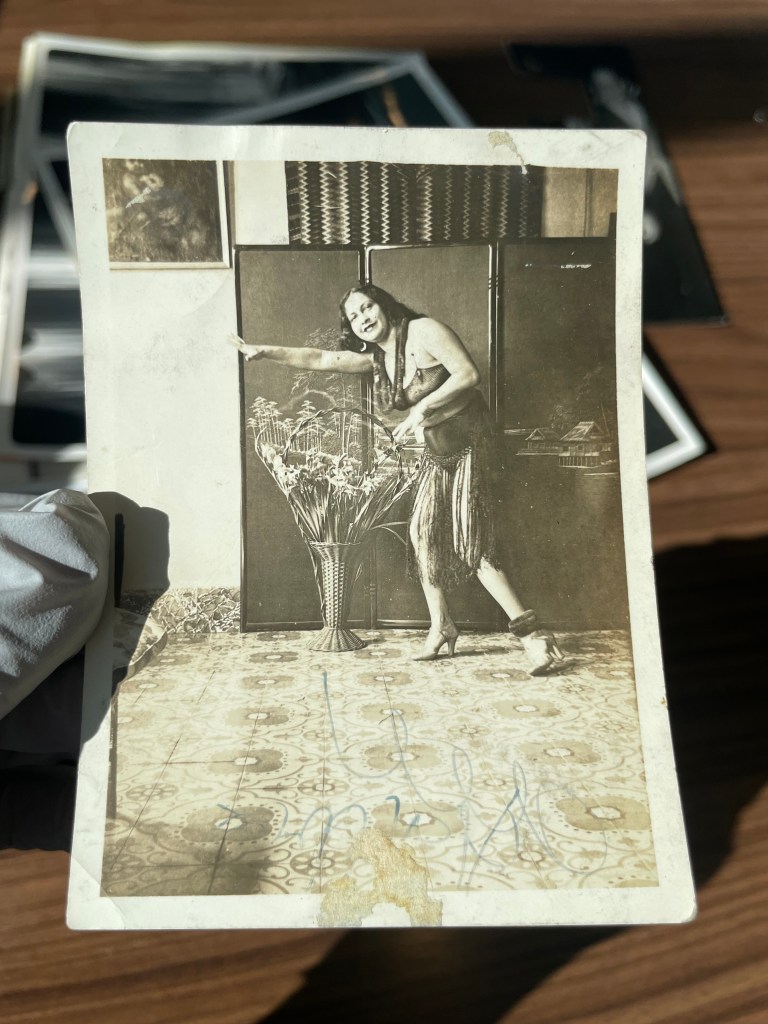
The house was arguably the most famous place to find sex workers in Cuba, and it catered to an elite crowd. Like Casa Marina, but within a lower tier was another brothel run by female impersonator Jilkana, and as luck would have it, I soon found a photo of him in the Rolando Laserie Papers [3]:
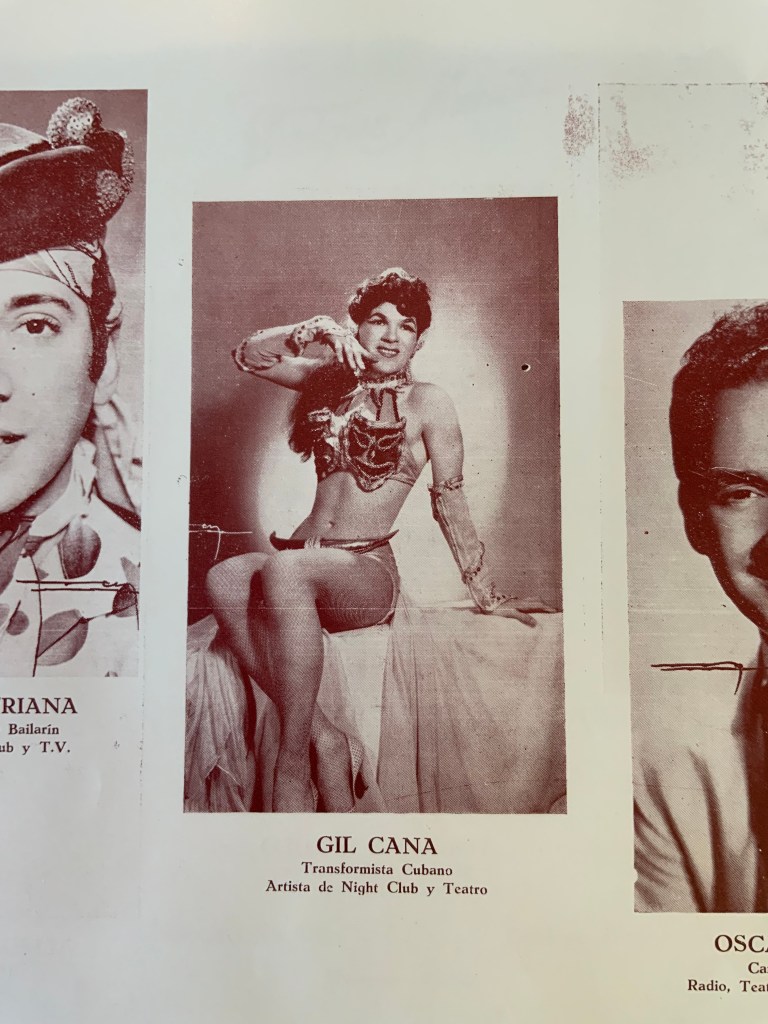
What was the place of queer and trans people in the world of midcentury sex work? To begin answering this question I requested the Tomás Fernández Robaina Papers [4] after finding the testimonies of two female sex workers published by this scholar [5]. Since both women had conducted their business prior to 1959 and Robaina’s work has also touched upon the history of homosexuality in Cuba I was hoping to find an overlap. Within his papers I found a monogram titled “The Prostitution in Cuba: Past and Present” [6] which I have yet to review. Other resources I consulted include “Yiyina: un testimonio” [7] about sex work before 1959 in Santiago de Cuba and an essay about sex work as a means of independence for Black women in the nineteenth century [8]. Diving into this topic has helped me to connect the instances I have recorded of queer and trans Cubans in the midcentury world of sex work and begin to understand them as more than merely isolated events.
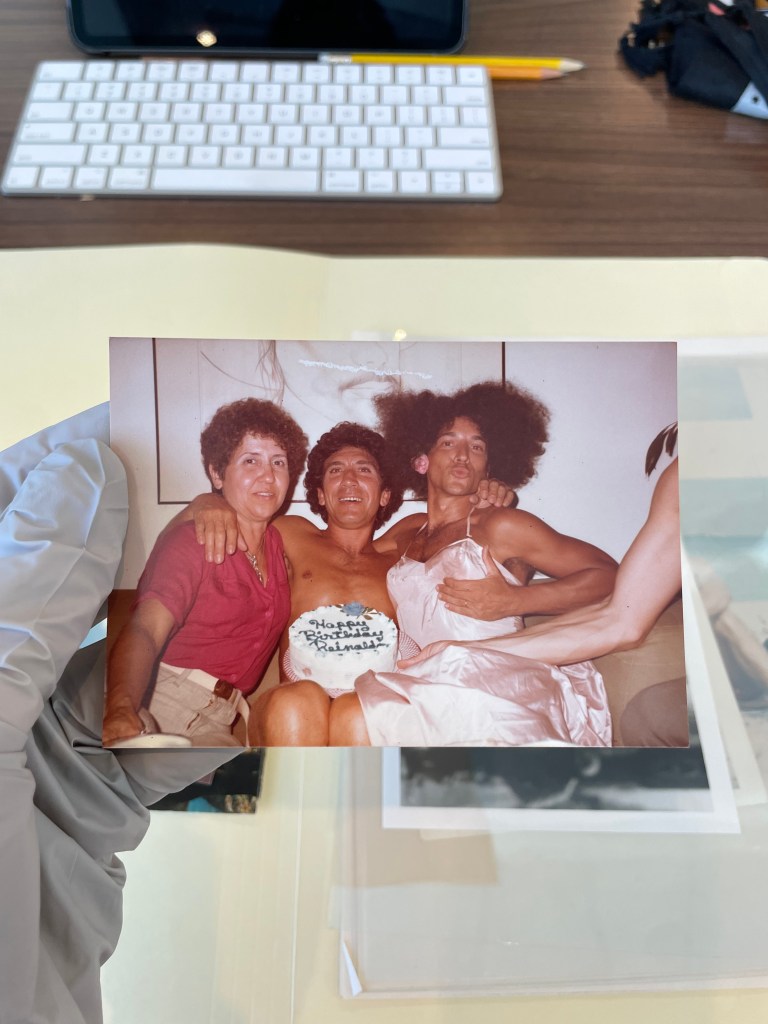
Then, in a continued effort to branch out of the research with which I was familiarized, I reviewed the entire list of journals available at CHC, ignoring the mainstream Bohemia, Carteles, Social, etc (since they are mostly available online), while focusing on those that covered topics such as art, gossip, fashion and satire. The magazine “Gente de la Semana” [9] was especially promising as it discussed sexuality (including non-hegemonic identities), gender relations, divorce, etc. Finally, and in the interest of my broader work with Cubanecuir, I reviewed the Rene Cifuentes collection [10] which contains correspondence, inside jokes and exquisite photographs of Reinaldo Arenas and Cifuentes in a uniquely queer context: crossdressing at Reinaldo’s birthday, collages of newspaper headlines that read “The widow of Elvis Presley calls Fidel very homosexual” and ephemeral notes that poke fun at high level gay intellectuals in Cuba.
My unsurmountable gratitude to the Cuban Heritage Collection and its guardians for their trust and deeply rooted commitment to accessibility. To Amanda, Juan, Gladys, Luis, Nelsa, and Annie who gracefully managed every inquiry and request I had. My time at CHC was crucial to my research on midcentury Cuban transformismo and I hope to share more of my findings in a publication very soon.
[1] Rosell, R. (1990). Vida y milagros de la farándula de Cuba. Taller.
[2] Rosell, R. (2016). Rosendo Rosell Papers [Collection]. University of Miami Libraries. https://atom.library.miami.edu/chc5386
[3] Laserie, R. (2009) Rolando Laserie Papers [Collection]. University of Miami Libraries. https://atom.library.miami.edu/chc5123
[4] Fernández Robaina, T. (2013) Tomas Fernández Robaina Papers [Collection]. University of Miami Libraries. https://atom.library.miami.edu/chc5168
[5] Fernández Robaina, T. (1998). Historias de mujeres públicas. Editorial Letras Cubanas.
[6] Fernández Robaina, T. (2013) The Prositution in Cuba: Past and Present [Document]. Tomas Fernández Robaina Papers [Collection]. University of Miami Libraries. https://atom.library.miami.edu/chc5168
[7] Gross, D. G. (2007). Yiyina: un testimonio: la prostitución en Palma Soriano antes de 1959. Ediciones Santiago.
[8] Hevia Lanier, O., & Rubiera Castillo, D. (2016). Emergiendo del silencio : mujeres negras en la historia de Cuba. Editorial de Ciencias Sociales.
[9] Gente de la semana. La Habana, Cuba: [publisher not identified]. Print.
[10] Cifuentes, R. (2016). René Cifuentes Collection [Collection]. University of Miami Libraries. https://atom.library.miami.edu/chc5554
 Cuban Heritage Collection Blog